
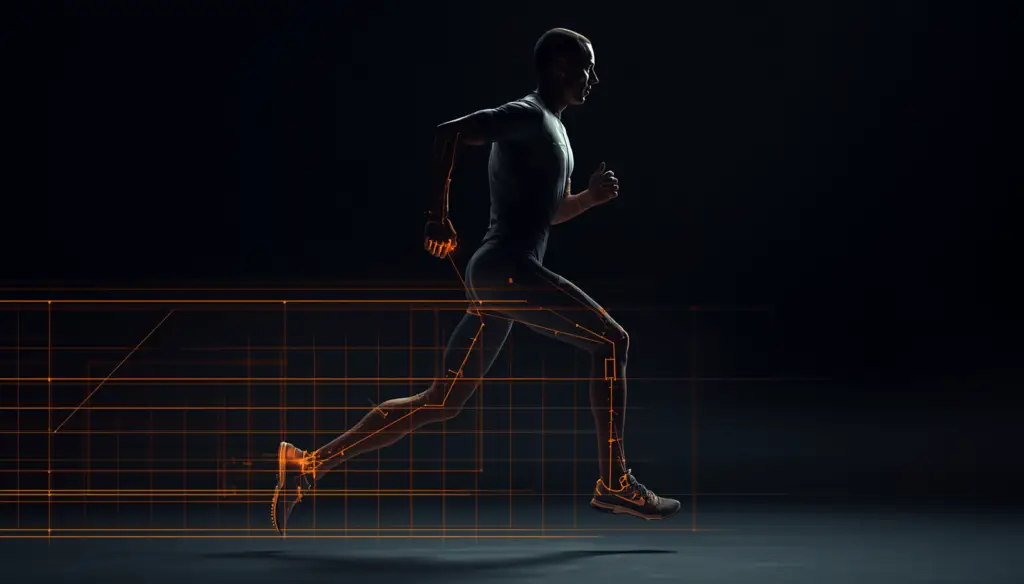
Here's a question almost no runner can answer honestly: How do you actually run?
Not how fast. Not how far. How. Where does your foot land? Does your knee collapse inward on impact? Does one hip drop lower than the other? Is your left leg doing more work than your right without you ever knowing it?
Most runners have no idea. They've run thousands of kilometres on a movement pattern they've never once seen from the outside. They feel the niggles — the tight ITB, the cranky knee, the calf that always goes first — but they're guessing at the cause.
Gait analysis ends the guessing.
It's the single most useful thing you can do to understand your running — and it's the foundation of the entire MOVE approach. Here's what it is, why it matters, and why every runner, from first-timer to sub-3 marathoner, should get one.
What Gait Analysis Actually Is
Your gait is your unique pattern of movement when you walk or run — the way your feet strike the ground, how your ankles, knees, and hips absorb and transfer force, and how your whole body coordinates through each stride.
Gait analysis is the process of capturing that pattern and reading it. At MOVE, we use AI-assisted video analysis to record you running and break down exactly what your body is doing — frame by frame — in ways the human eye simply can't catch at full speed.
Think about it: when you run, each foot is on the ground for roughly a quarter of a second. Everything that matters — the strike, the roll, the push-off — happens faster than you can perceive. You can't feel a 5-degree knee collapse. You can't sense that your right foot overpronates more than your left. But a slowed-down, AI-analysed video shows it clearly.
That's the difference between guessing and knowing.
You've run thousands of kilometres on a movement pattern you've never seen. Gait analysis is the first time you get to watch yourself run — and finally understand why your body does what it does.
Why Observation Comes Before Everything Else
The MOVE System is built on four pillars: Mind, Observation, Visualization, Education. Gait analysis lives at the heart of Observation — and there's a reason Observation has to come before you spend a cent on gear or change a single thing about your training.
You can't fix what you can't see. You can't choose the right shoe if you don't know how you load your foot. You can't solve a recurring injury if you don't know the movement pattern causing it. You can't train smarter if you're working off assumptions instead of evidence.
Observation is the truth-telling step. It replaces "I think my shoes are wrong" with "I can see exactly how my foot strikes and what that means for me." It turns a vague frustration into a specific, solvable problem.
Everything else in the MOVE System builds on what Observation reveals.
What a Gait Analysis Actually Reveals
A proper gait analysis isn't just "you overpronate, buy these shoes." Done well, it tells a full story about how you move. Here's what we're looking at:
Your Foot Strike
Where does your foot first make contact — heel, midfoot, or forefoot? None of these is automatically "wrong," but each has implications for the forces travelling up your leg, the shoes that suit you, and the injuries you're prone to.
Pronation and Foot Roll
After your foot lands, it rolls inward to absorb shock. Some inward roll is normal and healthy. Too much (overpronation) or too little (supination) changes how force moves through your ankle, shin, and knee — and it's directly linked to a long list of common running injuries.
Knee and Hip Mechanics
Does your knee track straight, or collapse inward on impact? Does one hip drop lower than the other through your stride? These patterns often explain ITB syndrome, runner's knee, and that nagging one-sided pain that no amount of stretching seems to fix.
Left-Right Asymmetry
Almost everyone is slightly asymmetrical. The question is how much, and whether it's costing you. A significant imbalance means one side is overworking — a fast track to injury and a ceiling on your performance you never knew was there.
Cadence and Stride
How many steps per minute are you taking, and how long is each stride? Overstriding — reaching your foot too far in front of your body — is one of the most common and most fixable causes of inefficiency and injury in runners.
Who Actually Needs a Gait Analysis? (Everyone — Here's Why)
There's a myth that gait analysis is only for serious, competitive runners. That's backwards. Here's who benefits, and why:
If You're New to Running
This is the best possible time to get analysed. You're building habits and buying your first proper gear. A gait analysis means you start on the right shoe for your body, build good mechanics from day one, and avoid the injuries that sideline so many beginners in their first few months. You skip the expensive trial-and-error that burns most new runners.
If You're Chasing a PB or Racing Seriously
You're training hard, tracking everything, and still hitting a plateau or fighting recurring niggles. Gait analysis often reveals the missing piece — the asymmetry, the overstride, the inefficiency that's quietly capping your performance no matter how many kilometres you log. If you obsess over your HR zones and your VDOT, it makes no sense to leave your actual movement pattern as the one variable you've never measured.
If You Keep Getting Injured
Recurring ITB pain. Shin splints that come back every training block. A knee that flares up the moment your mileage climbs. These aren't bad luck — they're patterns. And patterns show up clearly on a gait analysis. Instead of treating the same injury over and over, you finally see the root cause.
The Honest Truth
Most runners spend money on shoes, supplements, watches, and race entries before they ever spend an hour understanding how their own body moves. That's backwards. Observation should come first. It makes every other decision smarter — and saves you from the expensive mistakes most runners make.
Why You Can't Do This on Your Own
You might be thinking: can't I just film myself on my phone and watch it back?
You can film yourself. But filming isn't analysing. The value isn't in the footage — it's in knowing what you're looking at. A 5-degree knee deviation, a subtle pronation difference between feet, an overstride of a few centimetres — these are invisible unless you know exactly what to look for and how to interpret it.
That's where AI-assisted analysis plus a trained eye changes everything. The AI catches what the human eye misses at speed. The trained interpreter explains what it means for your body, your injuries, and your goals — and translates it into a clear, practical action plan. Footage without interpretation is just a video of you running. Analysis is the answer.
What Gait Analysis Sets in Motion
Here's what makes gait analysis the smartest first move in your running journey: it doesn't just give you information — it makes every decision afterwards better.
- Your shoe choice becomes precise. Instead of guessing or buying what's trendy, you choose the shoe that matches how your foot actually loads.
- Your injury risk drops. When you understand your movement pattern, you can address weaknesses before they become injuries.
- Your training gets sharper. Knowing your mechanics lets you target the right strength work, the right cues, the right adjustments.
- Your confidence grows. You stop guessing about your body and start making informed decisions backed by evidence.
This is the foundation. Once you can see how you move, everything else in the MOVE System — the gear, the training, the goal-setting — has something solid to build on.
Stop Guessing. Start Knowing.
You've run enough kilometres on assumptions. It's time to see how you actually move — and what it means for your running.
📍 Book your AI Gait Analysis at MOVE today.
One session. A complete picture. A smarter path forward.
You can't improve what you can't see.
Let's show you how you move.
Read next:
- The MOVE System Explained: Mind, Observation, Visualization, Education
- How We Choose the Brands We Stock at MOVE
- Coming next: AI Gait Analysis at MOVE: What Happens During Your Session