
Post 2 of 30 | MOVE Sports Centre Blog
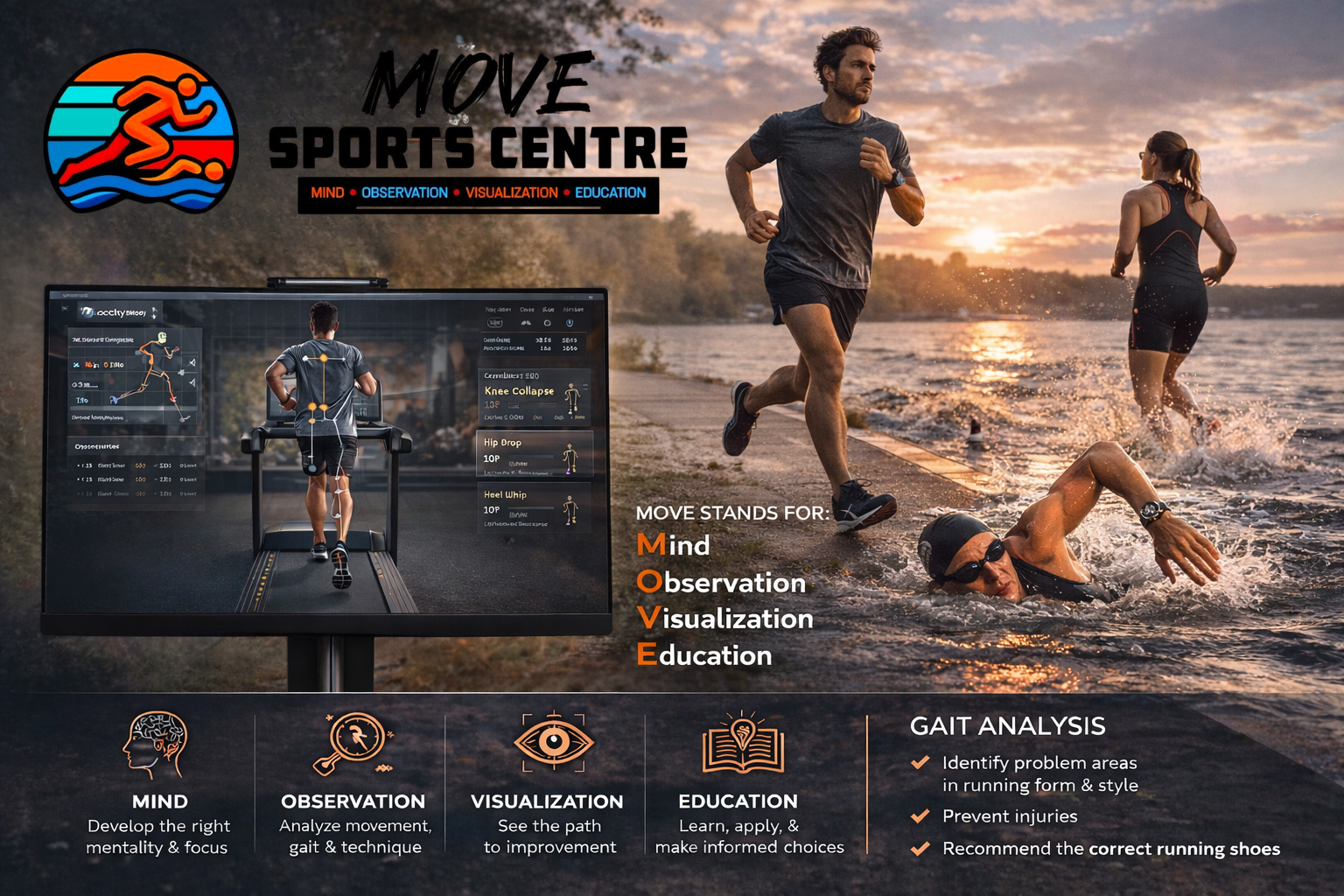
You bought the shoes. You followed the plan. You showed up. And you're still stuck. Here's why: most athletes focus on what they do — but never on how they think, see, and learn. That's where MOVE comes in. MOVE isn't just our name. It's our system. Four pillars that separate athletes who keep repeating the same results from athletes who actually break through. M — Mind. O — Observation. V — Visualization. E — Education. Every piece of advice we give, every product we recommend, every conversation we have with an athlete — it runs through this system. It's how we operate. And once you understand it, it'll change how you operate too. Let's break it down.
M — Mind
Your body will only go where your mind has already been.That's not a motivational poster. That's a fact. If you line up for a race already telling yourself "I just want to finish," you've already set your ceiling. You're not racing — you're surviving. And surviving is not a performance strategy.Mind is about what you say to yourself before you move, during the hard kilometres, and after the session is done. It's the conversation between your ears that nobody else hears — but that controls everything.Practical example: You're at kilometre 32 of a marathon. Your legs are heavy. Your pace is dropping. Most runners let the voice in their head say "just slow down, you've done enough." An athlete who trains their mind has already rehearsed this moment. They know what to say to themselves. They have a cue word. They have a plan for the pain. They don't react — they respond.Training your mind isn't optional. It's the first pillar for a reason.The question to ask yourself: What am I telling myself during my hardest sessions — and is that voice helping me or holding me back?
O — Observation
You can't fix what you can't see.Most athletes train blind. They run the same route, at the same pace, in the same shoes, and wonder why the same injuries keep coming back. They've never actually watched themselves move.Observation is about honest data. Not feelings. Not guesses. Real information about how your body moves, where it breaks down, and what's actually happening underneath the effort.Practical example: A runner comes into MOVE with recurring knee pain. They've tried new shoes. They've stretched more. Nothing works. We film their gait. Within seconds, we can see it — their left hip drops on every stride, their ankle rolls inward, and their cadence is too low. The knee was never the problem. The knee was the symptom.Without observation, that runner would still be chasing the wrong fix.The question to ask yourself: When was the last time I actually looked at how I move — not just how I feel?
V — Visualization
Before you run a race, you need to see it.Visualization isn't daydreaming. It's not closing your eyes and hoping. It's deliberate mental rehearsal — building a picture of what success looks like so clearly that when you get there, your body already knows what to do.This applies to more than race day. It applies to your training week. Your nutrition plan. Your season goal. If you can't see it clearly, you can't execute it consistently.Practical example: An athlete wants to break 4 hours in the marathon. We don't just say "run more." We map it out. What does a 3:55 marathon look like per kilometre? What does the fuelling strategy look like at each aid station? What's the plan for the first 10km when you feel invincible and want to go faster? What's the plan for kilometre 35 when you want to stop?When you've visualized every stage of the race before you even lace up, race day isn't a mystery — it's a mission briefing.The question to ask yourself: Can I describe my next goal in specific detail — or is it just a vague wish?
E — Education
The athlete who knows more, performs better.That's not arrogance. That's reality. If you don't understand why you're doing something, you're just following instructions. And the moment the plan breaks — and it will — you won't know how to adapt.Education is about understanding your body, your gear, your nutrition, and your training well enough to make smart decisions on your own. Not because someone told you to. Because you actually know.Practical example: A runner asks us for a shoe recommendation. We don't just hand them a box. We explain what their gait analysis showed, why a stability shoe suits their foot mechanics, what the drop height means for their Achilles load, and when they should replace the shoe based on their weekly mileage. That runner leaves MOVE not just with a product — but with knowledge they'll carry into every run.An educated athlete is a dangerous athlete. In the best way.The question to ask yourself: Do I understand why I train the way I train — or am I just following what someone else posted online?
How It All Connects
These four pillars don't work in isolation. They feed each other.A strong mind gives you the discipline to actually show up for an observation session. What you observe about your body gives you real data to visualize a better plan. And education gives you the understanding to execute that plan with confidence — which strengthens your mind for the next challenge.It's a cycle. And the athletes who commit to all four pillars — not just the ones they're comfortable with — are the ones who actually improve.
Where MOVE Sports Centre Fits
This system isn't just theory for us. It's built into everything we do.When you walk into MOVE, we don't just ask "what shoe do you want?" We ask how you're training, what your goals are, and what's getting in the way. We run AI Gait Analysis so you can see how your body actually moves. We educate you on the gear, the nutrition, the strategy — so you leave sharper than when you walked in.We don't sell products. We develop athletes.If you've read this far, you're already thinking differently. That's Mind working.Now take the next step.Come see us at MOVE Sports Centre in Middelburg. Book an AI Gait Analysis. Ask better questions about your training.Because once you start applying all four pillars, you don't just move.You move with purpose.
Next week: Why Most Athletes Plateau (And What to Do About It)