
You've decided to book a gait analysis. Smart move.
But now the next question kicks in: What actually happens in there? Do you need special gear? Will you feel awkward running on a treadmill while someone watches? How long does it take? What do you walk away with?
If you've never done one before, the unknown can make you put it off. So let's clear all of that up right now.
Here's exactly what happens in a 30-minute AI Gait Analysis session at MOVE — start to finish, no surprises, no fluff.
Before You Arrive: What to Bring
Keep it simple. Two things:
- Your current running shoes. Even if they're old, even if you're not sure they're right — bring them. Part of the analysis involves looking at how you run in what you're wearing now, because the wear pattern and the way you load them tells us a story before you've even stepped on the treadmill.
- Comfortable running gear. Shorts or tights, a top you can run in without overheating. Nothing flashy, nothing technical required. Just what you'd wear for a normal training run.
That's it. No need to "train up" for it. No need to be at peak fitness. You're not being judged — you're being measured.
When You Arrive at MOVE
You'll be greeted by one of our team — either myself or a trained MOVE staff member, depending on your booking. The first few minutes aren't about running. They're about you.
We'll sit down for a short conversation covering:
- Your running history. How long have you been running? How many kilometres a week? Do you run road, trail, or both?
- Your goals. Are you training for a specific race? Building toward your first 10K? Chasing a PB?
- Your injury history. Any recurring pain, niggles, or past injuries? Knees, shins, ITB, hips — we want to know what your body has been telling you.
- Your current shoes. What are you running in? How many kilometres are on them? How do they feel?
This conversation isn't a formality. The context shapes everything that comes next. The same gait pattern means different things for a beginner building up to a 10K versus a triathlete training for an Ironman 70.3. Your story matters.
A gait analysis without context is just a video of someone running. With context, it becomes a personalised roadmap for how you move and what to do about it.
On the Treadmill: The Recording
Now the running starts. You'll step onto our in-store treadmill — a quality, well-maintained machine specifically set up for gait analysis work. Nothing intimidating. The space is private and comfortable.
We'll start you at an easy warm-up pace for a minute or two, just to let your body settle into a natural rhythm. Most people feel a bit self-conscious for the first 30 seconds — that's normal. By the time the recording starts, you'll have forgotten anyone is watching.
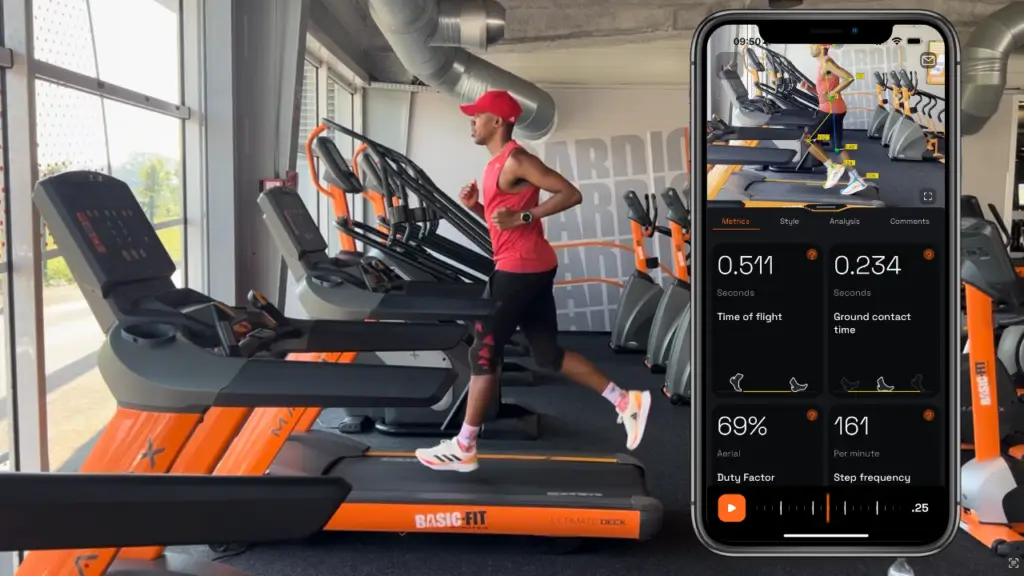
Then we capture the footage. From multiple angles. AI-assisted video that records each foot strike, each transition, each frame of your stride in detail no human eye can follow at full speed.
You might run for 3-5 minutes total. That's all we need. Once a body settles into its natural pattern, more time doesn't give us more information — it just gives us more of the same footage.
What We're Actually Analysing
The AI does the heavy lifting on the measurement side. It tracks dozens of data points across every stride — joint angles, foot contact timing, body alignment, cadence — at a resolution and speed the human eye simply cannot match.
What we're looking for, frame by frame:
- Foot strike. Heel, midfoot, or forefoot — and what that means for the forces travelling up your leg.
- Pronation and roll. How your foot rolls inward after impact. Too much, too little, or just right.
- Knee tracking. Does your knee drive straight, or collapse inward on impact? This is one of the biggest injury predictors we look at.
- Hip stability. Does one hip drop? Are your hips rotating evenly through each stride?
- Cadence and stride length. Are you overstriding? Are you taking efficient steps for your build?
- Asymmetry. The most overlooked piece. How different is your left side from your right — and is it costing you?
The AI flags the patterns. The trained interpreter translates them into what they mean for your body, your goals, and your injuries. Footage without interpretation is just video. The combination is what gives you answers.
The Walkthrough: Seeing Yourself Run
This is the part most people don't expect to find as powerful as it is.
After the recording, we sit down together and watch it back — slowed down, frame by frame, with the AI's analysis overlaid on the footage. You see your foot strike in detail. You see the angle your knee makes at impact. You see exactly how your right side compares to your left.
For most runners, this is the first time they've ever seen themselves run from the outside. It's eye-opening. Patterns you'd never have guessed suddenly make sense. The recurring knee pain finally has an explanation. The reason your right calf always goes first becomes visible.
We walk you through what we're seeing, what it means, and what to do about it. No jargon dump. No pretending it's more complex than it is. Just a clear picture of how you move and what the next steps look like.
What You Walk Away Knowing
Your foot strike type. Your pronation pattern. Your left-right asymmetry. The likely cause of any recurring niggle. The exact shoe category that fits your mechanics. And a clear sense of what to work on next.
Your Same-Day Report
Within the same day, you'll receive a written report via email or WhatsApp covering:
- A summary of your gait pattern and what we observed
- Key findings — what's working, what needs attention
- Specific shoe recommendations matched to your mechanics
- Suggested next steps if recurring issues showed up — strength work, mobility, technique cues
This is yours to keep. Refer back to it when you're shopping for new shoes, when you're starting a new training block, when a coach asks about your mechanics. It's a personal reference document built specifically for your body.
What It Costs (And Why That Matters)
Here's something we do differently. An AI Gait Analysis at MOVE is free with the purchase of a pair of running shoes.
This isn't a gimmick. It's a principle. We believe the analysis has to come before the shoe choice — because choosing shoes without knowing how you move is exactly the trial-and-error trap that costs runners thousands of rand over the years.
So we bundle the two. You get the analysis, the insight, the report — and the right shoe for your mechanics, in one visit. No guesswork. No buying twice. No starting a training block in shoes that work against your body.
It's the smartest way to start, restart, or upgrade your running journey.
A Few Things It's Not
So you walk in with clear expectations, here's what an AI gait analysis at MOVE isn't:
- It's not a fitness test. We're measuring movement, not VO2 max. You don't need to be fit to do it.
- It's not a medical diagnosis. If you have a serious injury, we'll happily flag what we see and recommend you involve a biokineticist or physio — but we're not replacing medical professionals. We're complementing them.
- It's not a sales pitch. We're not trying to upsell you. The analysis stands on its own. If the right shoe for you is a budget-friendly option, that's what we'll recommend.
- It's not intimidating. No matter your level — first-time runner or seasoned racer — the process is the same, the welcome is the same, and the value is the same.
Ready to See How You Move?
30 minutes. A treadmill. AI-assisted analysis. A same-day report.
And the right pair of running shoes for your body.
Free with any shoe purchase at MOVE.
📍 Book your AI Gait Analysis today.
30 minutes to understand how you've been running your whole life.
That's a trade worth making.
Read next:
- What Is Gait Analysis (And Why You Need One)
- How We Choose the Brands We Stock at MOVE
- Coming next: Overpronation, Supination, Neutral — What Your Gait Type Actually Means